

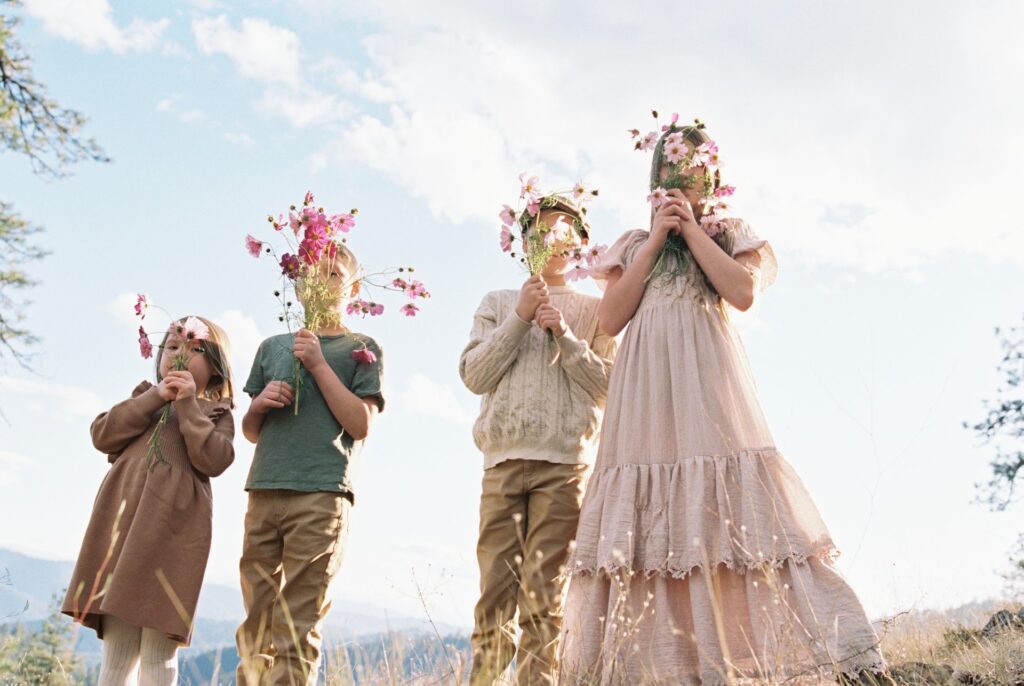
Space to Get Weird, Thanks to Kodak Portra 400 Film
Kodak Portra 400 film has a reputation for being the safe choice. We like to view it as the reliable older brother of the Kodak film family. The one that’s consistent and forgiving. The one you count on to keep all the kids corralled in chaotic shopping mall energy.
But when watching Anna Nelson work, safe is the last word that comes to mind.
She’s the photographer pulling a random CD out of her bag to catch and create artsy reflections, encouraging gymnastics on couches, and likely has notes scribbled across her hands (arms, sometimes even legs) like a not-so-covert conspiracy theorist.
But somehow, all of that instinct, emotion, and chaos lands in a photograph that brings that emotion gushing in with Niagara Falls impact.
Her secret weapon?
Not as the star of the show, but as the thing that makes everything else possible.
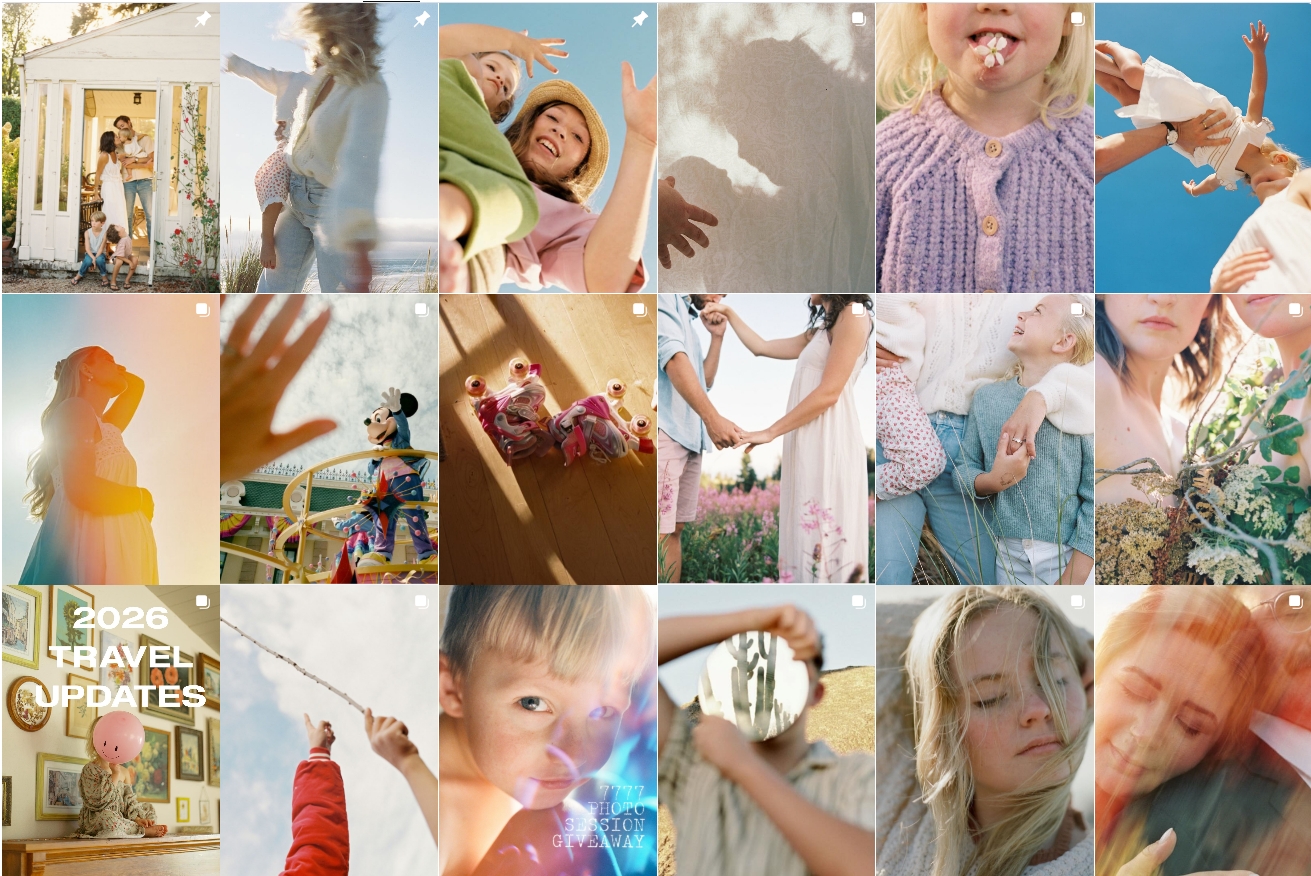
Why Kodak Portra 400 film works for Anna Nelson’s creative process.
Quick note: If you’ve noticed Kodak referring to it as Ektacolor 400, that’s just a naming shift, not a change in the film itself. Same film. Same performance. Same quiet reliability. Think of it like a costume change at a Taylor Swift concert. Still the powerhouse voice but in a new, show stopping outfit.
Kodak Portra 400 film has stayed a relevant staple for film photographers for a reason. It handles light in a way that feels forgiving without being flat. It holds skin tones softly without washing them out. It gives you room to lean into overexposure without completely losing the image.
For photographers like Anna, that reliability isn’t about playing it safe. It’s about giving yourself healthy space to let your imagination create something unencumbered.
Kodak Portra 400 film is one of the most widely used film stocks for a reason. It handles a handful of lighting conditions, has super forgiving latitude, and delivers soft, natural tones that work really well for portraits.
For many photographers, it becomes a kind of baseline. A film they can trust to perform consistently, even when everything else is unpredictable.
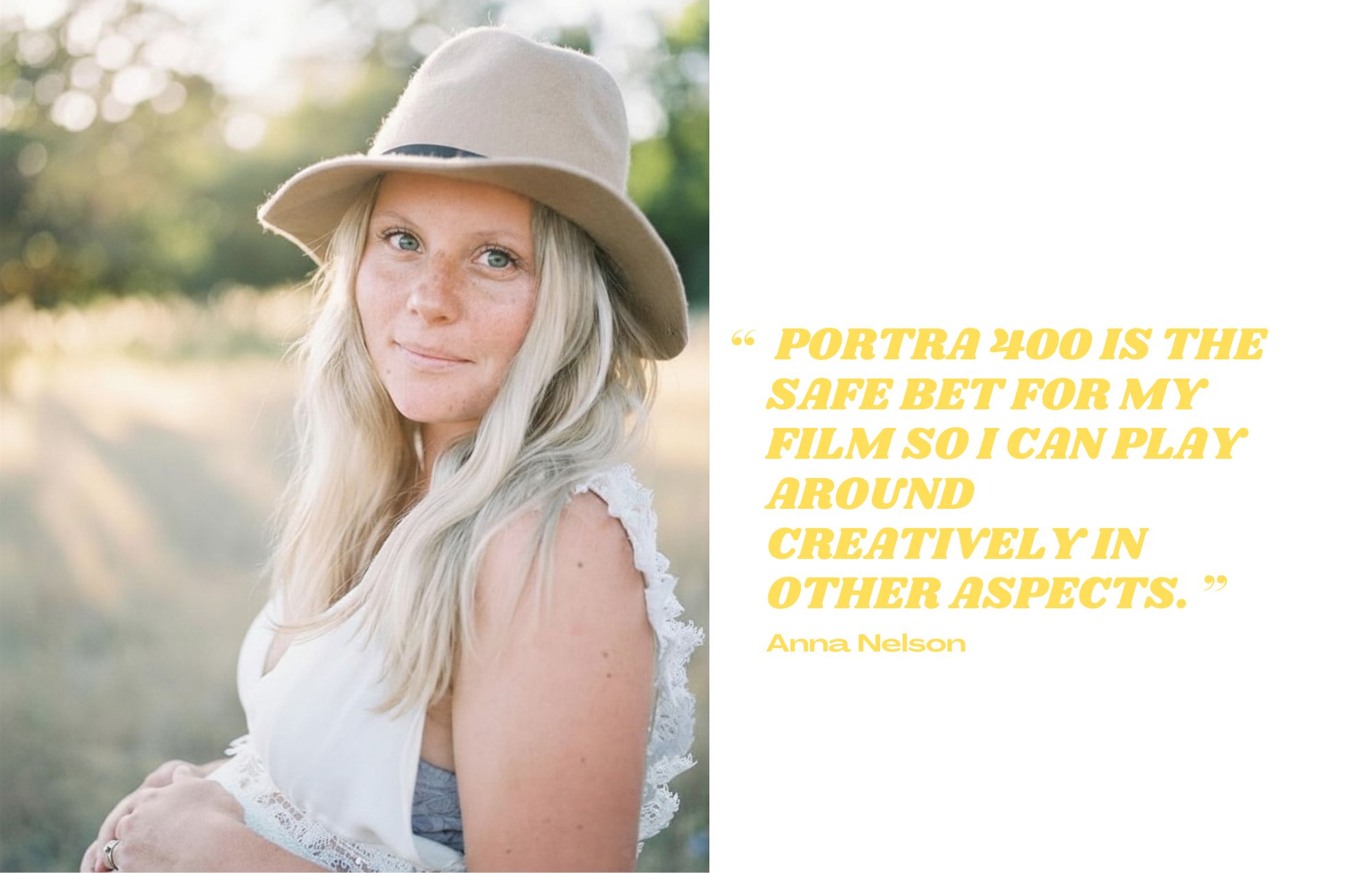
Portra 400 film as a Creative Safety Net
Anna describes it as her “safe bet.” Not because it’s boring, but because it gives her room to push everything else further. There’s a special kind of confidence you carry when you rely on a film that doubles as a security blanket. You suddenly feel safe taking more risks, pushing limits, and going a little buck wild in the creativity department.
If it wasn’t already a copyrighted quote, “What would you attempt to do if you knew you could not fail?” by Dr. Robert H. Schuller would be the tagline.
When your film stock is consistent, you stop worrying about whether it will work and start focusing on how far you can take an idea.
And that feeling she wants to chase but can’t fully explain yet?
That’s where Anna thrives.
Kodak Portra 400 film becomes the constant in all of that movement. The glue that holds the image together while everything else in the process gets to be a little more unpredictable and free-spirited.
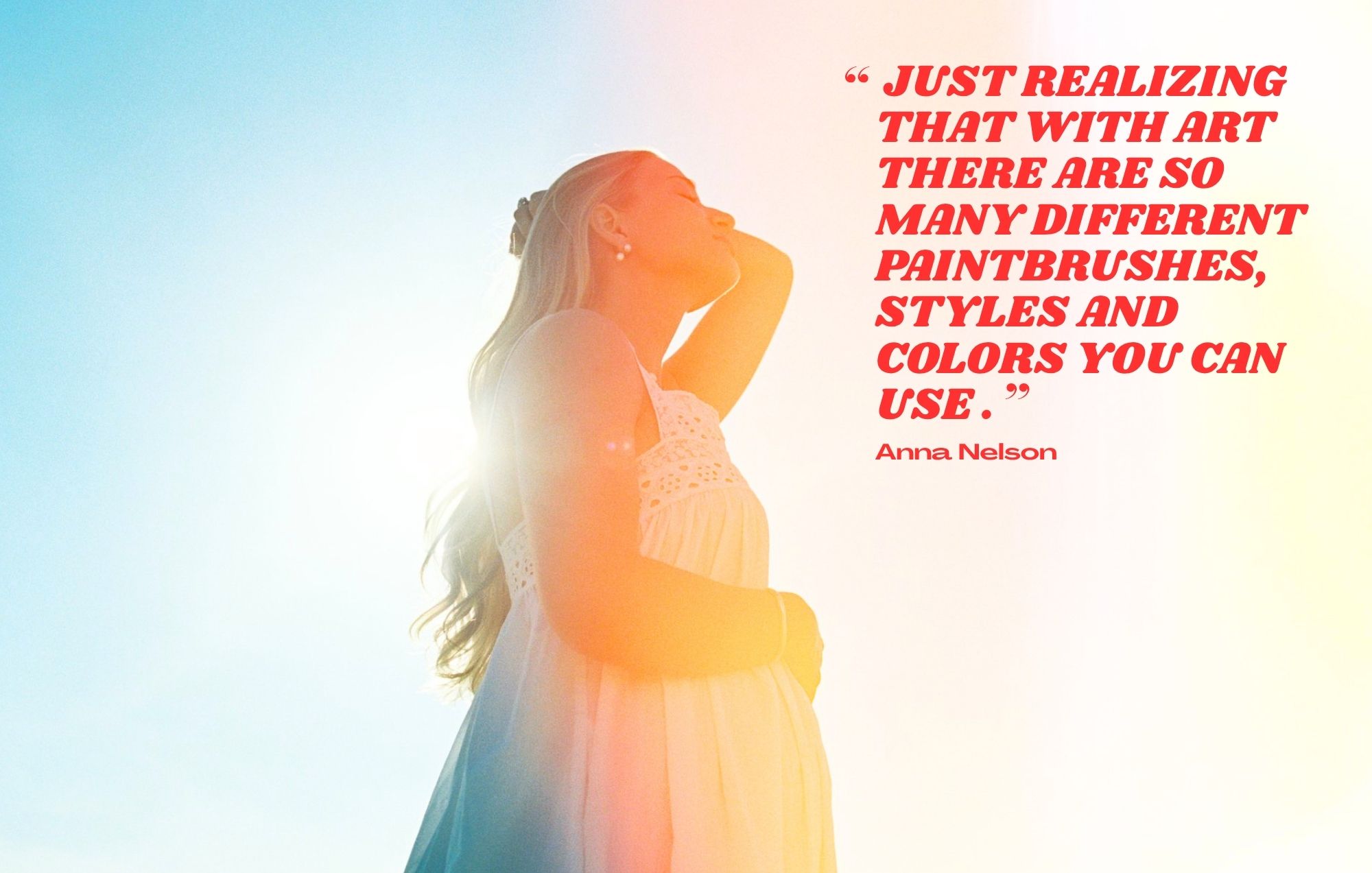
Leaning into the Weird in Her Creative Process
Anna’s creative process came after a bit of an identity shift. When the photography world was awash with neutral tones and light and airy palettes, she just wasn’t feeling the spark. She finally realized there isn’t one way to make art.
“There are so many different paintbrushes, colors, and styles you can use. It’s so much broader than I had known at the very beginning.”
With that realization came freedom.
“You don’t have to do what everyone else is doing. I thought that I had to stay in this safe box and follow that same formula in order to shoot film photography. But now I know I can do whatever I want, because it’s an emulation of me.”
Now Anna’s creative process starts with a pull. A kind of intuition that’s entirely her own. When she’s deep in brainstorming mode, weeks before a shoot, you’ll find her wandering through craft store aisles, waiting for something to catch her attention.
Something sparkly? Into the cart.
Something bold in color but completely outside her norm? Also coming home with her.
She doesn’t always know why but she trusts it.
Just like she trusts her film, she trusts her process.
Naturally, over time, that trust has turned into proof.
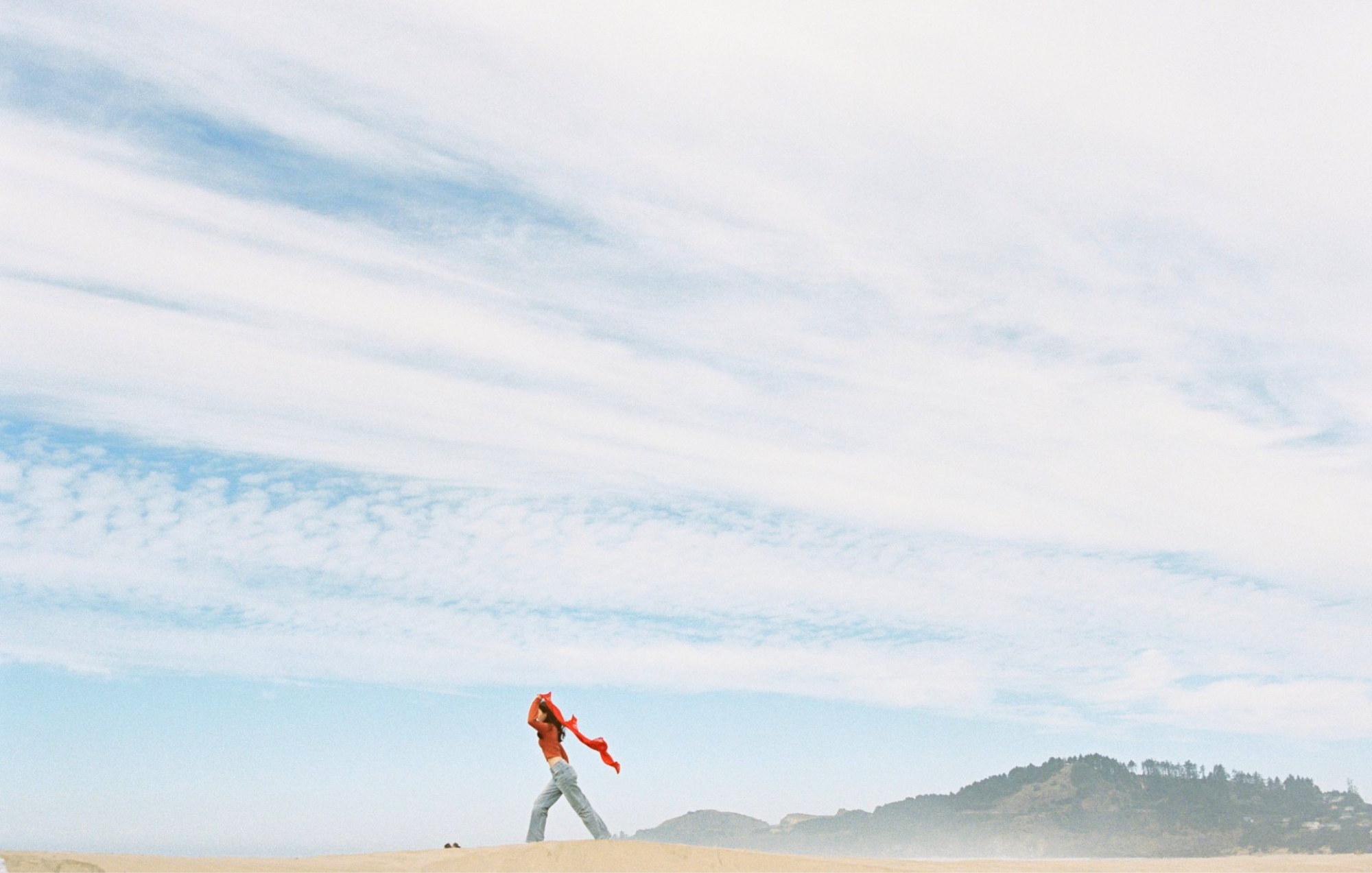
photo by Anna Nelson 2025
Sometimes intuition looks like a red piece of fabric
On one of those craft store trips, she came across a piece of vibrant red fabric. Not her norm at all. It didn’t match her usual palette, didn’t “fit” anything she had planned.
She bought it anyway.
At the session, she had the kids run through the sand dunes with it, letting it catch the wind, twist, and move naturally with them. It felt playful. A little unexpected. Beautiful, but not overly thought out.
Later, she found out the mom, also a photographer, had a favorite photo of her daughter taken years earlier.
Same beach.
Same dunes.
Eight years before.
And in that photo?
Her daughter was wearing a billowy, red sundress.
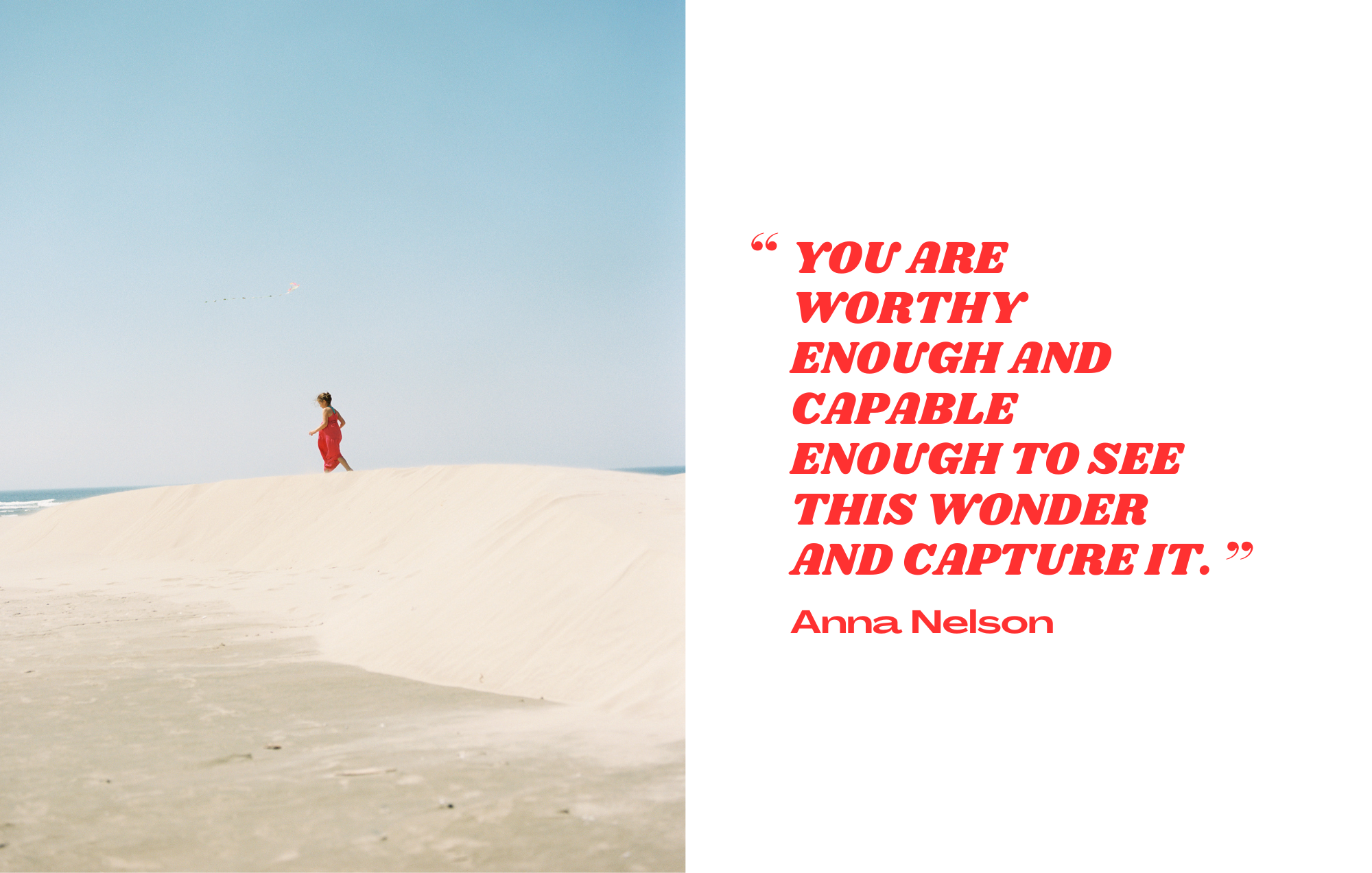
photo by Mylyn Wood 2017
There are moments you can plan and then there are moments that find you anyway.
Anna didn’t know why she bought the fabric. It didn’t fit her usual style. It didn’t match a shot list. It didn’t come with a clear explanation.
It just felt right, so she listened. And that’s the difference.
Not luck. Not coincidence.
This doesn’t happen unless you trust that instinct before it makes sense. This is a woman who has practiced listening to that quiet nudge long enough to trust it when it shows up. When you actually listen like that, when you follow something before it makes sense, you don’t just create something beautiful. You create something that feels deeply personal, and for a moment, sparks that childhood belief that magic and wonder really do exist.
What her work is really about
For Anna, none of this is about perfect lighting or technically flawless images. It’s not about chasing trends or recreating what’s already been done. It’s about something much simpler and much harder to fake. “As people, we just want to say… we were there together, and it happened, and it mattered, and we loved each other.”
Her goal is to not just to create something memorable, but to create something that feels like proof. Proof that a moment existed, that it was real, that it meant something.
Because to her, that is life. “Your life matters. Your love matters. It happened. It’s tangible… don’t forget this.”
The way she approaches photography reflects that. It’s not just about seeing people. It’s about helping them see themselves.
“It’s an act of love to see yourself and see others in this way… and giving them that gift of loving what they see in themselves.”
The kind of image where someone looks at it and thinks:
that’s me.
that’s my family.
I’m part of that.
Something they truly belong in. Something that reminds them they were part of the wonder all along.
Her work starting feeling more like her when she understood this simple truth.
“You are worthy enough to see this wonder and capture it… and then you get to give that sense of awe and beauty and love to someone else.”
And thats a gift and a responsibility she doesn’t take lightly.
Film vs Digital (and why this still matters)
There’s a point in every photographer’s journey where they try to make digital feel like film. Different presets, profiles, tweaks that get it close enough to pass.
But close enough isn’t the same thing. “Film is better than digital. You just can’t replicate the magic.”
It’s not about resolution or sharpness. It’s about how it feels. Film doesn’t just capture light, it interprets it.
Then there’s the part people don’t always talk about. That moment when you get your scans back and there’s one frame that just hits.
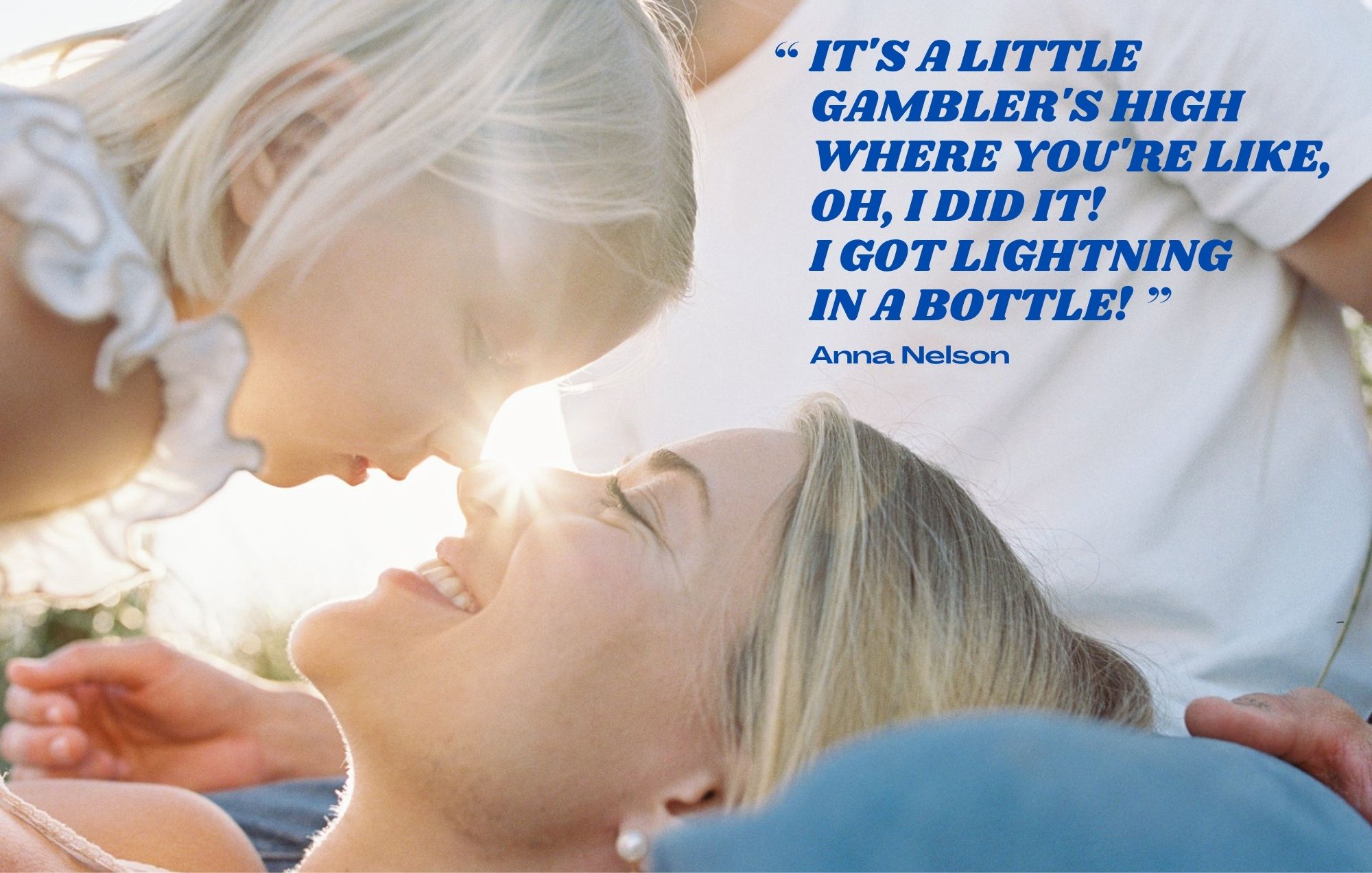
“It’s that little spark… like a gambler’s high. You’re like, oh, I did it. I got lightning in a bottle.”
And immediately your brain goes into excited, hyper mode thinking,
how do I do that again?
That’s the hook. That’s what keeps you hungry. That’s what keeps you coming back.
And over time, that hunger becomes something else.
Something quieter. Something deeper.
“Looking back now, I’m like… this has been such a healing part for me.”
Because it’s not just about getting the shot. It’s about learning to recognize those moments in the first place. To look for them, to stay open to them and to believe they’re there, even before you see them.
Where Inspiration Actually Comes From
Anna doesn’t pull inspiration from one place. It’s not neatly organized. It’s not sitting in a folder labeled “ideas that will definitely work.”
It’s more like a running mental tab of things that made her pause for half a second longer than usual and then never fully left. For someone whose music is entirely dependent on the weather in her brain, this makes perfect sense.
It shows up in the way kids interact when no one’s telling them what to do. In weird, offbeat art that makes you tilt your head a little. In dreams that feel random until suddenly they’re not. In those moments where something catches your attention and you don’t totally know why, but you know not to ignore it. It’s less about searching and more about noticing.
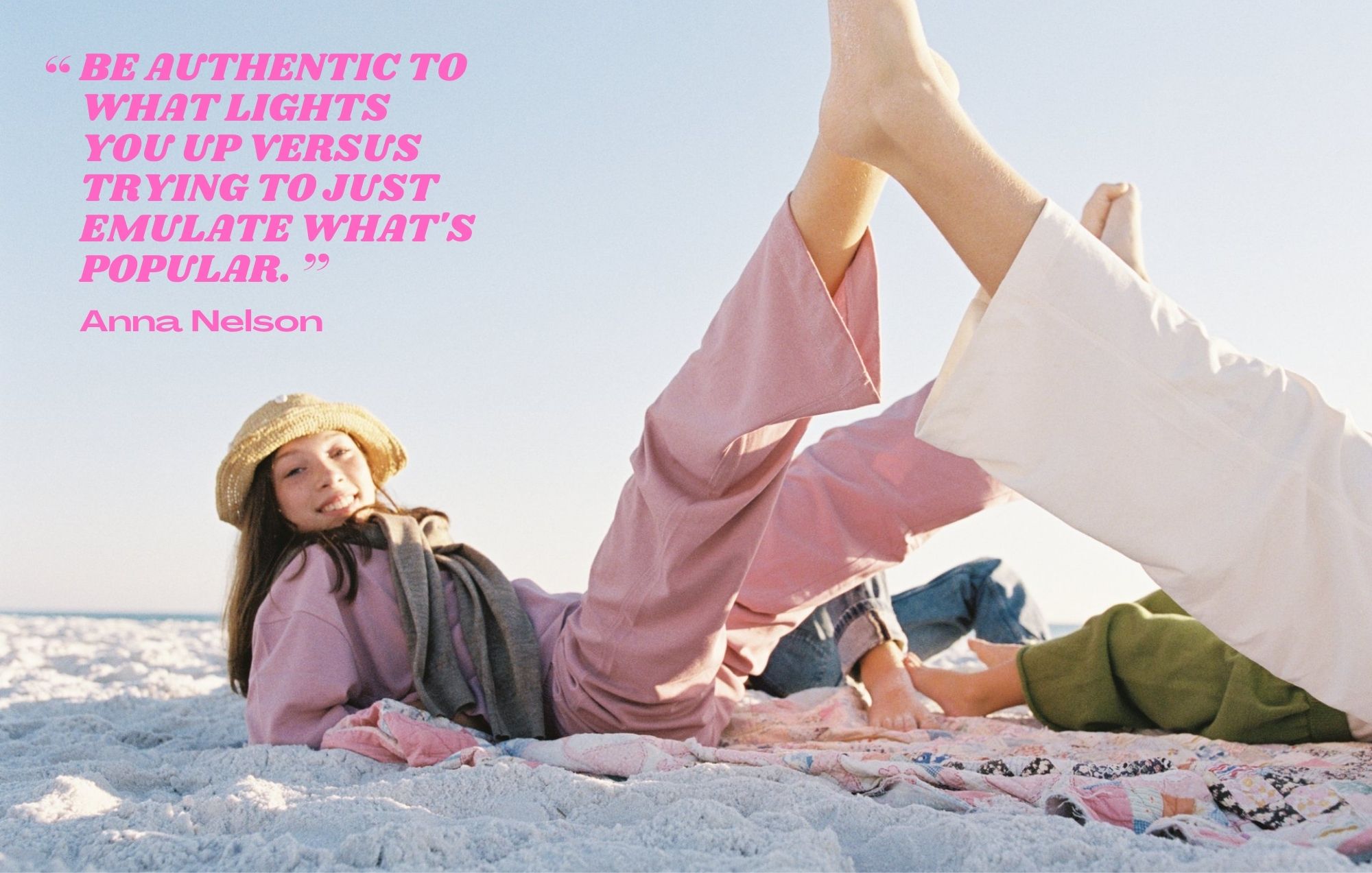
More importantly, it’s about trusting what you notice. For her that’s the real filter. Being authentic to what lights you up versus trying to emulate what’s popular, successful, or what you think you’re supposed to be doing.
Which sounds great in theory until you realize how easy it is to default to “what’s working for everyone else” instead.
But that’s not where her work comes from.
It comes from following the slightly weird instinct. The one that doesn’t fully make sense yet. The idea that might flop or might be the one that makes everything click.
At this point, she’s learned something important:
the things that don’t make sense at first?
Those are usually the ones worth paying attention to.
Portra 400 in Context
Kodak Portra 400 film isn’t the only option.
Compared to Kodak Portra 800, it gives you more control in balanced light.
Compared to Kodak Ektar 100, it trades bold saturation for softer, more natural tones.
It’s not trying to be the loudest film in the room, it’s trying to be the one you can rely on.
For a process that depends on instinct, movement, and moments you can’t fully plan, thats a big part of the equation.
What Happens After the Shutter
This is not a girl who sends her film on logistics alone.
When so much of what she creates lives in subtle color shifts, emotion, and those in-between moments you can’t recreate, the way her film is handled afterward matters just as much as how it’s shot.
When she looks for a home base for her film scans, three things matter most.
1. Color consistency that protects the feeling
Understanding how Anna sees color, and being able to translate that consistently, is everything.
Her work leans heavily on emotion, and color is a huge part of how that emotion lands. When she’s shooting on Kodak Portra 400 film, she’s making intentional choices about softness, warmth, and tone in real time. That subtle, lived-in feeling? It’s not accidental.
If that shifts in scanning, even slightly, the entire image shifts with it.
A lab that understands her visual language well enough to interpret it consistently so it’s true to what it felt like when she pressed the shutter? That’s priceless.
2. Communication that feels like an actual relationship
Customer service is a huge one for her. But not in the generic, “they responded quickly” kind of way. In the can I actually talk to you kind of way. “Being able to have a working relationship where you can talk with your lab… I feel like is so important.”
Because they weren’t there when the photo was taken. They didn’t feel what she felt. They didn’t see the moment unfold. They’re interpreting it from the scan. If you don’t have communication, that interpretation can drift.
“If you’re unhappy with your scans and the second you get a bad scan you jump somewhere else… you’re never gonna develop that relationship.”
Which is the whole point.
3. A partnership that gets better over time
It’s not about finding a perfect lab on day one. It’s about building something.
“In the sake of longevity of a partnership with a film lab… you have to be able to communicate what you want and be on the same page.”
Just like anything else, it gets better with time. The more they understand how she shoots, how she sees color, what she’s going for emotionally.
The less she has to explain and the more the work comes back feeling like hers.
The Part You Can’t Fake
At the end of the day, Kodak Portra 400 film isn’t what makes the work feel like magic. It’s just what makes space for it.
The real difference is in how Anna sees, how she listens, and how she trusts something before it fully makes sense.
When all of that lines up, when the moment, the instinct, and the follow-through meet in the same place, you get something that doesn’t just look beautiful.
You feel it.
Anna Nelson is a traveling hybrid photographer based in southern Oregon. She specializes in creating art that tells the world your life matters, your love matters and gives you the gift of believing in magic again. Keep up with Anna and her adventures on Instagram by following her here.
Do you love Portra 400 just as much as Anna? Tag us @photovision.co and use #Photovisionfilmlab so we can see what you are creating out there in the wild!